Lemon Pudding
Creamy, ultra smooth homemade lemon pudding. This is made with eggs and yolks (no starch) and has a sharp lemon flavor. It can be served as a standalone dessert with a whipped cream finish, or used as a topping/filling for other baked goods and desserts.

I almost love this lemon pudding as much as my lemon curd. Almost. It’s truly wonderful but it’s a bit softer in flavor and sharpness, it’s creamier too and – unlike my lemon curd which is sharp – I could eat a whole bowl of this by the spoonful.
I had started experimenting with homemade lemon pudding when I made this lemon lush dessert for my substack, in summer of ‘24. When I decided to extract just the pudding recipe to put on this blog, I thought it would be an easy lift. The pudding I made was fine! Delicious!
Recipe Origins & Testing Notes
But I made it again and again, and I could not get the right consistency or texture. It worked for the lemon lush, where it was a layer in a pie-like dish that was kept cold and served in between a few other things. As a standalone dessert it was much too thin and droopy. So I tested and retested this about a dozen times, sometimes adding starch (against my will), and playing with the liquid amounts versus the eggs (the only thickener I wanted).
In the end I was able to leave out the starch, as I really wanted to make a pudding that had an excellent and smooth texture with just eggs and yolks (a dish is always creamier and smoother made like this) at the expense of leaving out some of the dairy. Ultimately I found I actually really loved the result: because this meant the lemon flavor, with its bright and tart juice and fresh zest, was even stronger without the excess dairy.
The result of about a year and a half’s worth of recipe testing is this: the best lemon pudding I can imagine. It’s got a very lemony flavor, it’s tart in that zingy way, and it’s the smoothest creamy lemon pudding ever.

Recipe Ingredients
Sugar: fine granulated sugar.
Lemons: wash and rub them before zesting, to remove any residue from wax.
Eggs & egg yolks: from large eggs.
Salt: fine sea salt.
Heavy cream: or heavy whipping cream. If you aim to make this dairy free, try a soy or plant based heavy cream.
How to make Lemon Pudding
If you have an immersion blender, you can start right in the pot (notes on what kind of pot to use below). If not, use a bowl.
Zest the lemons over the sugar (avoid the white pith), then rub it in: with your fingers. This releases the oils in the zest that give the pudding a bright, sweet flavor.

Blend the lemon sugar with the salt and eggs: use an immersion blender or a regular blender (or food processor). This is to break up any egg white bits.

Set a heavy bottomed, non-reactive, pot over medium heat. Add the egg/sugar mixture to it along with the heavy cream and lemon juice, whisk it well.

Cook, whisking frequently, as the pudding heats up and cooks it will start to thicken. It will thicken on the bottom first, where it is closest to the heat. Sir so that it heats all of it evenly – you don’t want the bottom curdling because it’s cooked too quickly.
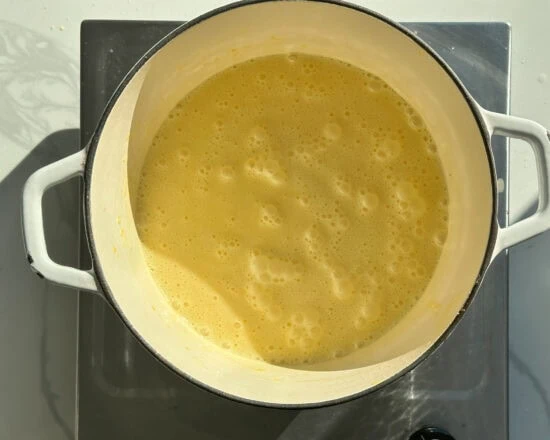

Keep an instant read thermometer nearby; when the pudding gets to about 170-175 F, it will be thick enough to coat the back of a spatula. This is when it’s done cooking.

Pour it through a fine mesh sieve (to remove the lemon zest) into a bowl, scraping the bottom of the sieve as needed and pressing to remove as much as possible.

If serving as individual desserts, divide the pudding into smaller bowls and, once it’s at room temperature, cover with plastic wrap. If using as a filling, store in an airtight container.
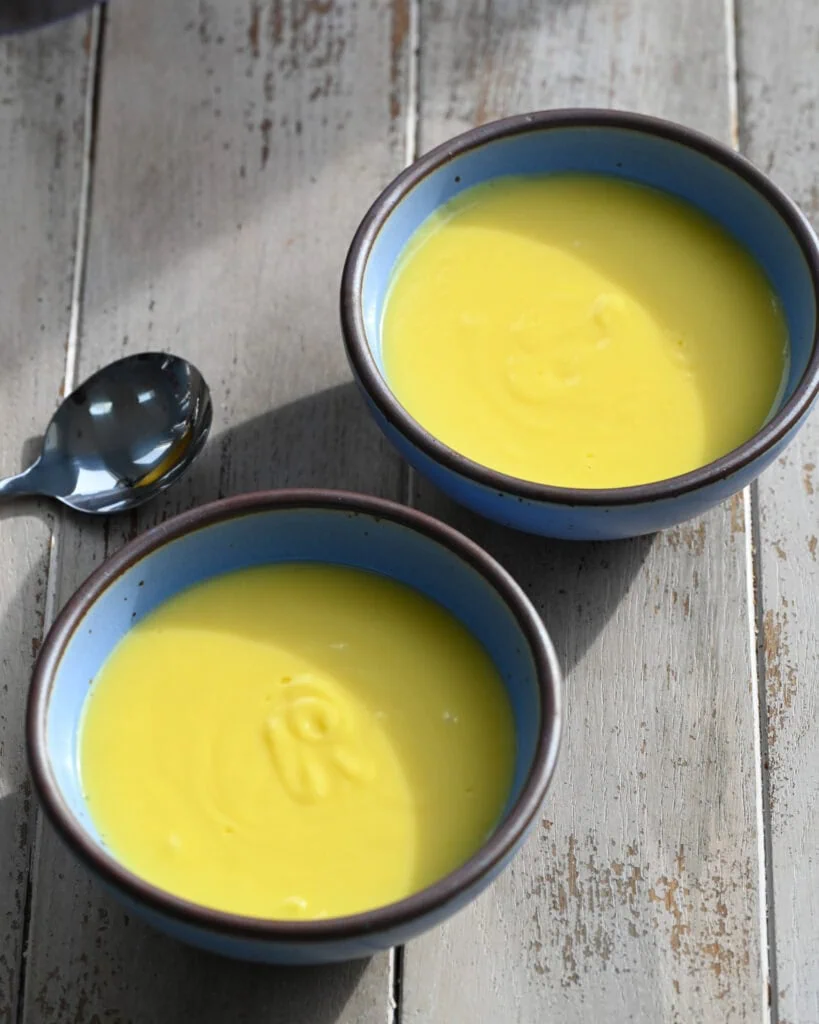
Let the pudding chill for at least four hours before eating, to thicken.
Troubleshooting
My pudding is too sour.
When zesting the lemons take care to avoid the white pith that’s under the yellow zest. That is the stuff that will make a lemon dish sour, rather than tart.
This is too tart for me.
You can reduce the lemon juice slightly or increase the sugar to make it less tart.
My pudding would not thicken.
Chances are you need to give it more time to cook and to stir it more frequently. Be patient, this is a big batch of pudding and it will take time to fully cook and get the temperature above 170 F.
My pudding tastes metallic, what happened?
It’s possible your pan was not non-reactive. Non-reactive pots are usually either stainless steel or enamel coated cast iron (ceramic too, though less common). Because this is an acidic dish, it can react with the pan material itself.

FAQ
Can I use meyer lemons?
Yes! It will be a softer lemon flavor, not as sharp – but many people prefer it this way.
Can I use limes and make a lime pudding?
Yes! But be careful when zesting limes; their skin is much thinner and you’ll get to the white pith much quicker. If you get that in your pudding it will be sour.
How long does the lemon pudding keep?
The pudding will last about 5-6 days in the fridge, kept nicely chilled and in an airtight container.
Can I halve the recipe?
Yes! Because you have less of everything, remember the pudding will cook quicker so keep a closer eye on it. Here’s your half batch ingredient list: 100g or ½ cup fine granulated sugar, Zest of 2 lemons, 2 eggs plus 2 egg yolks from large eggs, Pinch fine sea salt, 120g or ½ cups heavy cream, 65g or scant ⅓ cup lemon juice.
What can I serve the pudding with?
I like to just do a whipped cream, this stabilized vanilla whipped cream is my favorite with the pudding.
Lemon Pudding Recipe
Lemon Pudding

Ingredients
- 200g or 1 cup fine granulated sugar
- Zest of 3-4 fresh lemons
- 4 eggs & 4 yolks large
- ¼ teaspoon fine sea salt
- 240g or 1 cup heavy cream or heavy whipping cream
- 130g or ½ cup plus 1 tablespoon lemon juice freshly squeezed
Method
- If you have an immersion blender: Zest the lemon over the sugar (avoid the white pith) into a heavy bottomed, non-reactive pot. Rub the zest into the sugar to release the oils. Add the eggs and salt then use the immersion blender to blend until there’s no egg white that’s unmixed.
- If you don’t have an immersion blender and are using a regular blender or food processor: start by adding the sugar to a bowl and zest the lemons into it (avoid the white pith) and rub the zest into the sugar until it’s like wet sand. Set the sugar in the blender/food processor and add the eggs, then blend until smooth and there’s no unmixed egg bits. Transfer to a non-reactive pot (stainless steel or enamel coated cast iron).
- Add the heavy cream and lemon juice to the pot and quickly whisk to combine. Set the pot over medium heat. Whisk as it heats, it will turn into a smooth liquid. Stir frequently as it thickens - it will thicken first on the bottom, whisk/stir to ensure it cooks evenly. When the temperature reaches 175 F remove from heat. Pour though a fine mesh sieve into a bowl.
- If serving individual desserts, divide the pudding into the bowls and once they are at room temperature cover with plastic wrap and set in the fridge to chill for at least four hours, until cool and thick.
- If using as a filling later, set the pudding in a container that has a lid - once it’s at room temperature, cover and chill for 6-8 hours before using. The pudding will keep in the fridge for about 5 days, if you need it to keep longer freeze it.
Did you make this recipe?
Share & tag me on instagram @buttermilkbysam


A hit!
the best I’ve ever tasted. I’m making it again REAL soon.
OMG, this is the single best lemon dessert I’ve ever made. I was a little anxious about the heavy cream in there, since I don’t typically like sour+dairy. But I shouldn’t have worried — this was perfection. Exactly the right blend of tart and sweet, texture smooth and silky. I immediately texted the recipe link to all the cooks I know, and am making it again tonight, less than a week later! Thank you.
Emily I’m absolutely STOKED to hear this! Thank you for taking a chance on the recipe 😀