Double Strawberry Pavlova
Strawberry pavlova with double the strawberry flavor: this crispy exterior and marshmallowy middle pavlova is flavored with strawberry powder which gives it a slight tart taste. Serve it with unsweetened vanilla whipped cream and fresh sliced strawberries.
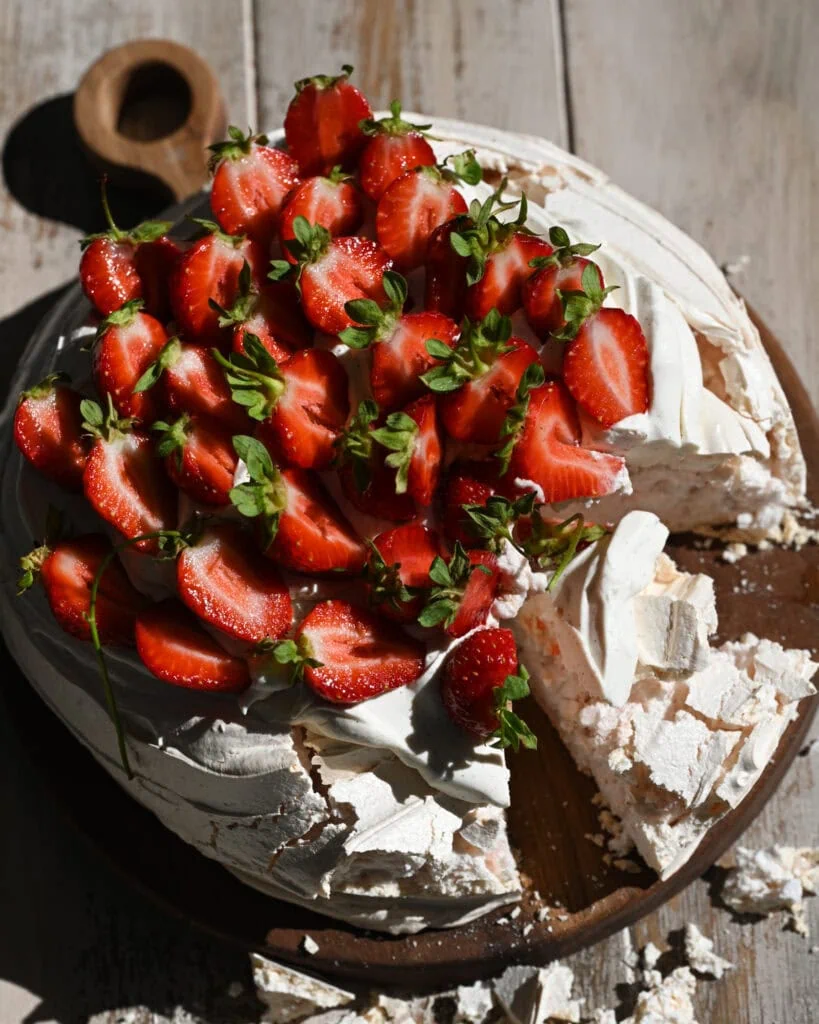
While I love a regular pavlova, I almost always want to do something to change the basic flavor. I’m usually more successful doing this with meringue pie toppings where the meringue is served right after whipping and requires very little special care (other than being torched). Baked meringues and pavlovas are far more sensitive to acidity changes, undissolved sugar granules and mostly, to heat.
While I can usually knock a pavlova out pretty easily, this one took far more recipe testing than usual. I had to balance the acidity within the meringue itself; pavlovas usually add vinegar or lemon juice but this can be too powerful when adding another ingredient. I also made many attempts at different temperatures as I find the recommended baking temp/time range to be quite wide. In the end I opted for a lower heat held over a longer period.
Recipe Origins
This recipe more or less follows the making of a standard pavlova. Nigella Lawson’s strawberry pavlova is usually my guide, but I make some changes: warming my sugar before adding it to the whipping egg whites (to ensure it dissolves), using cream of tartar instead of vinegar as my acid (this is partially because it helps stabilize the egg whites and partially because the strawberry powder has some acidity as well as I discovered in my recipe testing), and I bake it at a lower temperature for longer (per a comment on the recipe). I find this helps with pavlova structure formation and its ability to hold that structure as it dries out.
I also add a wildcard ingredient which turns this strawberry pavlova into one that doubles down on the strawberry flavor: strawberry powder. This is just ground up freeze dried berries, sifted to remove any seeds. It gives the pavlova more sweetness and a little bit of a tart taste, taking it from a basic vanilla to one with a bit of a bright edge.
To my substack followers, you’ve seen something like this before in these mini strawberry pavlovas. I’ve had to make some small changes to accommodate a bigger meringue with a more temperature sensitive constitution.

Recipe Ingredients
Egg whites: with absolutely NO egg yolk in them. If there is even a bit of yolk, it will inhibit the meringue from forming its structure.
Cream of tartar: this is the acid that will keep the pavlova fluffy inside. It will also stabilize the egg whites as they whisk.
Sugar: fine granulated sugar. If your sugar is not “fine” run it through a food processor before using.
Salt: fine sea salt.
Vanilla: pure vanilla paste.
Freeze dried strawberries: we need about a quarter to a third of a cup to make 1.5-2 tablespoons of strawberry “powder”.
Starch: tapioca starch or flour. Cornstarch works too.

How to Make a Double Strawberry Pavlova
Prep
Draw a circle: on a piece of parchment with a pencil, draw a 6 inch circle. Flip this parchment over and use it to line a greased cookie sheet. This circle will help guide you to shape the pavlova.

Warm the sugar: spread it in a small baking pan and turn the oven to preheat to 325 F. This step means the sugar will be hot going into the whipping egg whites and this will help it dissolve quicker.
Whip the egg whites: Set the egg whites in a very clean stand mixer bowl (some people suggest wiping it with vinegar to clean it of any residual oil) and affix the whisk attachment. Turn it to medium low speed and begin whisking, when it’s frothy on top add the cream of tartar. Then keep whisking until it’s frothy even at the bottom.

Make the meringue
Slowly add the sugar: once the oven has preheated and the sugar is hot (it’s OK if it has colored a bit) check that the egg whites are frothy all over then, one spoonful at a time, add the sugar. Try to avoid it going to the sides and instead aim for the center bottom of the bowl, right where the whisk is working. Once all the sugar is in I tend to stop the mixer and use a rubber spatula to scrape the sides – to get any lingering granules.
Beat to stiff peaks: Keep the mixer on medium speed, whisking, until the meringue starts to look thick, fluffy and holds stiff peaks (towards the end of whisking I add the vanilla and salt). When you can turn the whisk upside down and it holds shape, it’s done whisking.

Make the powder: freeze dried strawberries tend to soften when out of an airtight container so save this step for the end. Get about ¼ cup of the dried berries and press them as you break them through a fine mesh sieve, this will remove the bigger strawberry seeds. Once you have about 1.5 tablespoons of powder you can add it to the meringue.

Fold in the rest: add the starch and now use a clean large rubber spatula to carefully fold it (and the strawberry powder) into the meringue. You’ll be making the letter J with the spatula, and don’t worry about perfectly mixing it as it still has more opportunity to be mixed.

Bake
Dollop the meringue onto the prepared pan, keeping it within the circle you drew earlier.

Swiftly use an offset spatula to shape the meringue into a dome, making lines around the sides and dipping the spatula into the top center to make a small ‘well’ shape.

Set the pavlova in the oven and lower the temperature to 300 F. Bake it for an hour, without opening the oven.
After that hour, lower the temperature to 275 F and bake for another 30-45 minutes, until the pavlova is firm to touch (gently open the oven to check it). Turn off the oven and let it cool completely in there – for a few hours. It will likely deflate as it cools.

When ready to serve, make the stabilized whipped cream (vanilla or chocolate!) and top with fresh, sliced strawberries.

FAQ
How far ahead of time can I make the pavlova?
Ideally make it the night before and let it cool and dry out in the oven overnight. If serving it in the evening, make it in the morning and leave it in the oven all day.
How long will the pavlova last?
Once assembled, serve it the day of. After that the pavlova will absorb humidity and soften, losing its signature crisp shell. The strawberries will also start to soften and release their juices all over the cream and pavlova.
Common Pavlova Problems and How to Prevent Them
Beading: this is when you see bubbles of amber forming on the pavlova’s outer shell. It is usually due to undissolved sugar in the meringue. One way to check a meringue before baking is to rub some of it between your fingers, if you find sugar granules those might spell beading later on so keep whisking.
Cracking: Most pavlovas will crack in the oven, this is normal. If it’s cracking substantially so much that it’s losing its shape, chances are the temperature of the oven is too high. Sometimes ovens have hot spots and if your pavlova is right under one, it can lead to cracking.
Collapsing: your beautiful pavlova has ballooned up and is looking gorgeous, an hour later you check it and the middle has collapsed and the whole thing is flattened. In my experience, this means the pavlova wasn’t heated high or long enough for the outer shell to firm and hold its structure. Check your oven with an additional thermometer so you know exactly the temperature.
Browning: unlike a regular pavlova, don’t expect this strawberry pavlova to be perfectly white. The strawberry powder is going to give it a bit of a tan, you’ll see it beige on the outside and pale pink inside. However, if it is substantially browning, the oven is too hot or was held too hot for too long of a period. Have that additional thermometer and monitor the pavlova as it’s baking.
Double Strawberry Pavlova Recipe
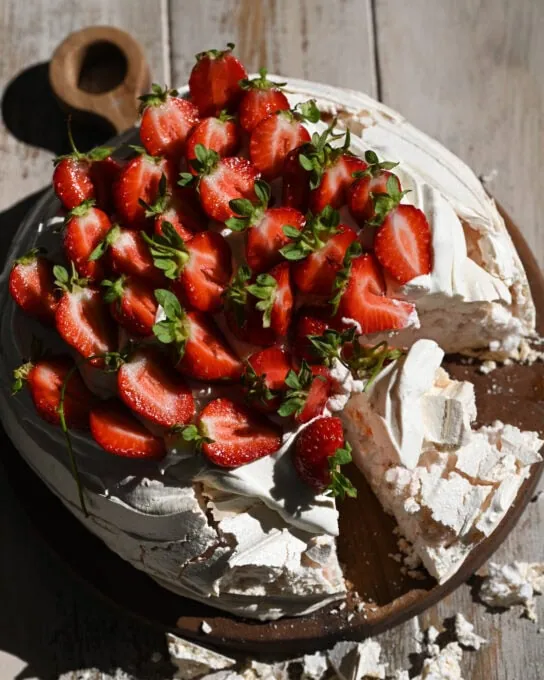
Double Strawberry Pavlova
Ingredients
- 6 egg whites from large eggs
- ½ teaspoon cream of tartar
- 325 g fine granulated sugar
- ¾ teaspoon fine sea salt
- 2 teaspoon pure vanilla extract or paste
- 1 ½ tablespoons strawberry powder from freeze dried strawberries
- 2 teaspoons tapioca flour/starch or cornstarch
- Stabilized whipped cream
- Fresh strawberries to top
Method
- Draw a 6 inch circle on a piece of parchment paper. Flip it upside down and place it on a greased cookie sheet.
- Spread the sugar on a quarter (or similar) baking pan and set it in the oven. Preheat the oven to 325 F (this warms the sugar so it dissolves quicker).
- Set the eggs in the bowl of a stand mixer (it should be clean and dry) and use the whisk attachment to begin whisking. Once it starts to foam at the top, add the cream of tartar. Keep whisking until the egg whites are fully frothy (even on the bottom).
- Slowly add the sugar to the whipping egg whites, one spoonful at a time, aiming for the middle of the bowl where the whisk is working. Once all the sugar is in, use a large rubber spatula to scrape the edges to ensure all the sugar is being whisked. Set the speed to medium and whisk until you get close to stiff peaks: the meringue should be thick, glossy and nearly hold shape. Add the salt and vanilla and whisk to stiff peaks, the meringue should hold shape when the whisk is turned upside down.
- Press about a quarter cup of freeze dried strawberries through a fine mesh sieve until you have about 1.5 tablespoons of strawberry powder. Add the powder to the meringue, along with the starch.
- Use a clean rubber spatula to fold the powders into the meringue, making large J shapes in the bowl. Don’t over do the folds, less the meringue breaks.
- Dollop the meringue onto the prepared pan within the circle drawn. Use an offset spatula to shape the pavlova into a pretty dome, making line swoops on the sides and indenting the top with a well (where the filling will go).
- Place the pavlova in the 325 F oven, then lower the temperature to 300 F and bake for 30 minutes. At 30 minutes, lower the heat to 275 F and bake for another 30-45 minutes until the pavlova is dry and firm to touch. Leave the pavlova to cool in the oven for a few hours or overnight before serving.
- To serve, dollop the whipped cream into the center where you made the ‘well” then pile on the fresh, sliced berries. Serve within the hour.
Did you make this recipe?
Share & tag me on instagram @buttermilkbysam


