Semolina, Almond and Coconut Cake
Sweet, syrup soaked semolina cake made with almond flour, coconut, brown butter, and orange zest. This cake has roots in basbousa, though it is less soaked, has a fluffier texture and a unique combination of flavors.
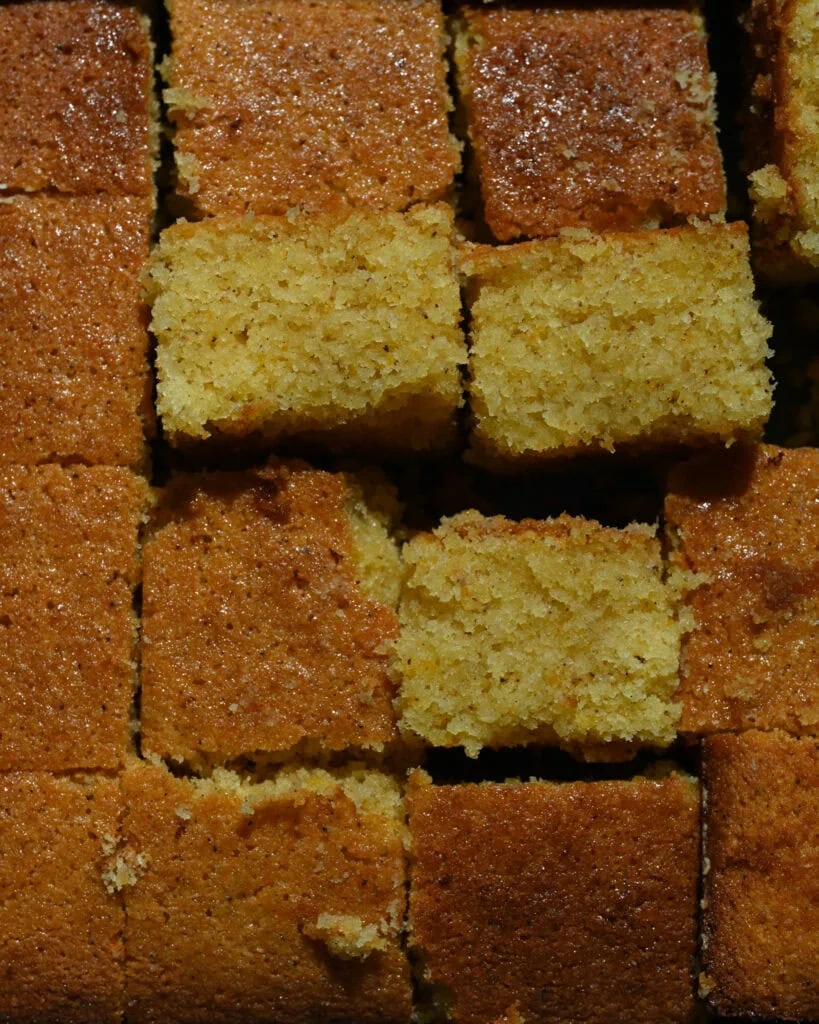
I’ve been meaning to give you a basbousa recipe (namoora to some), known simply as a semolina cake for years but it wasn’t until last week when I realized that this friday (my regular publishing day) both nowruz and eid fall on the same day… and I thought, I absolutely must crack this one to get it out to you on the day.
But first, note this isn’t a regular basbousa: I titled it as a semolina, coconut and almond cake because those are its main differentiators.
Ultimately this cake is something of its own, but if you’re a fan of this blog you might love it. It has all the usual trappings of a sam recipe: the butter is browned, the sweetness is just so, there’s a citrus element, and there’s this mosaic of flavors that unexpectedly all come together to make something unique.
Recipe Origins
This one of course starts with the basbousa (some call it namoora) recipes that I have made on and off over the years, namely from the classic cookbook, The Arab Table by May Bsisu (2005) and an older one that my mother had in her kitchen growing up, The Complete Middle East Cookbook by Tess Mallos (1979). I’ve adapted the recipe several times, hybridizing the two recipes (one uses eggs and yogurt, one uses just milk and butter) but this edition I’m sharing today is probably the furthest from the originals: I use some almond flour in place of the semolina as a nod to the almonds you’d traditionally find on top, more coconut than usual, I add orange zest, and I brown the butter.
The result is a cake that probably couldn’t ever classify as basbousa, but when you eat it you’ll recognize the bite of the semolina/coconut at once, and the syrup soaked edges. The difference is in the flavor; the orange and brown butter turn this into something a bit more layered in flavor, and texture; mine is a tad fluffier and thicker – it’s also less soaked, my preference.

Recipe Ingredients
Tahini: it’s traditional to spread tahini on the baking pan before adding the basbousa batter. It gives the edges flavor and keeps it from sticking.
Butter: unsalted, cold is fine (we’re browning it!)
Sugar: fine granulated. While it may be tempting to reduce the sugar added to the cake batter, it will cause the cake to be dryer and have a firmer crumb. Sugar adds moisture and gives it a softer texture.
Salt: fine sea salt. If using table salt, halve the amount.
Vanilla: pure vanilla extract.
Eggs: whole and large. At room temperature so they will beat more easily.
Semolina: fine semolina flour, not coarse.
Almond flour: not almond meal which has the nuts skins but blanched almond flour.
Macaroon Coconut: this one may be a bit more challenging to find but look at middle eastern stores or sections in the grocery store; it’s not just shredded coconut it’s very finely shredded, almost like a powder.
Baking powder: to leaven the cake.
Milk: Use whole milk.

How to make this almond, coconut & semolina cake
Prep
Brown the butter first, so it has time to cool. See this page for how to brown butter properly, in detail.
Once it’s browned, dip a tablespoon measuring spoon to take out a bit of butter to add to the glaze (Bsisu adds regular butter, she says it’s for shine, I loved the idea so I browned a little extra so we’d be able to use browned butter in the glaze).
Preheat the oven and grease the pan: this pan gets greased with tahini. It’s a small amount but gives the edges a lovely nutty flavor, and stops the cake from sticking to the pan.

Make the Batter
Beat or vigorously whisk together the eggs with the sugar and salt. If you’re using the orange zest, add it now. We’re looking for the mix to turn a pale yellow, add the vanilla as you’re beating.


Once the egg mixture has lightened considerably, and is airy, start to slowly pour in the browned butter while mixing. Be sure to scrape up all the bits of browned milk solids.
Mix this well until combined.

We’ll add all the ‘flours’ at once: the fine semolina, the blanched almond flour, and the coconut, along with the baking powder:
Pour in the milk and mix until the batter is nicely combined. It will be very lumpy and not smooth, that’s due to the coconut/semolina and almond flour.

Spread the batter in the tahini prepared pan, in an even layer.

Bake & Soak
Bake until it’s golden all over and when the center top is pressed, you can’t detect any liquid batter.
While the cake is baking, make the syrup by combining the sugar, salt, and water in a pot. Bring it to a boil then shut off the heat and add the butter, stir.

When the cake is just hot out of the oven, poke it all over with a cake tester or toothpick. Then pour the syrup all over – try to avoid it concentrating at the edges and make sure to pour in the center as much as possible while still covering the entire surface.
Let the cake cool as it absorbs the syrup. Serve warm or at room temperature.

Topping and Flavor Options
It is traditional to place some whole, blanched almonds on top of the cake where the slices will be cut. You can also use regular whole almonds or pistachios.
For flavor, to complement the orange zest you might like a drop or two of some orange blossom essence in the cake or the syrup.
The syrup can be flavored too, with a squeeze of lemon (this helps cut through the sweetness).
This is great on its own but if you are concerned it looks a little plain as is, I think it would be great with some vanilla ice cream.

Almond, Coconut & Semolina Cake
Almond, Coconut & Semolina Cake

Ingredients
Semolina Cake
- 2 tablespoons tahini to spread on the pan
- 175g unsalted butter
- 200g or 1 cup fine granulated sugar
- Zest of 1-2 oranges
- ½ teaspoon fine sea salt
- 1 teaspoon pure vanilla extract
- 2 large eggs
- 160g or 1 cup fine semolina
- 115g or 1 cup blanched almond flour
- 80g or 1 cup finely shredded dehydrated coconut "coconut macaroon" see notes
- 2 teaspoons baking powder
- 180g or ¾ cups whole milk
Simple Syrup
- 200g or 1 cup fine granulated sugar
- 120g or ½ cup filtered water
- Pinch fine sea salt
- 1 tablespoon browned butter reserved from above
Method
- Preheat the oven to 350 F. Use the tahini to spread around a 9 inch square metal pan, using your fingers to cover the bottom and sides.
- Set the butter in a light colored frying pan over medium low heat. Cook as the butter melts, then starts to sputter and foam, until all the bits that have dropped to the bottom of the pan have turned a deep toasty brown (not black). Immediately transfer to a heatproof bowl to cool. Set aside one tablespoon of the browned butter to add to the syrup, the rest will go into the cake batter.
- In a large bowl add the sugar and zest the oranges over it. Rub the zest into the sugar with your fingers. Add salt, eggs and vanilla. Use a hand mixer or a whisk to beat until the color of the mix has lightened several shades: it will go from being an orange-ish yellow to a pale yellow.
- With the mixer on, slowly pour in the browned butter for the cake - ensuring to get all the little brown butter bits in the bowl. Mix on medium speed until well incorporated.
- Add the semolina flour, coconut, almond flour, and baking powder and briefly mix. Pour in the milk and mix until the batter is combined (it will be lumpy overall and not smooth but there shouldn’t be any unmixed bits.
- Pour the batter into the prepared pan. Set in the oven on the middle rack to bake until the top is firm when pressed and it’s golden all over (but more so at the edges), about 35-40 minutes.
- When the cake is almost done baking, make the syrup by combining the water, sugar and pinch of salt in a small pot and setting it over medium low heat. Cook until the sugar dissolves and the syrup starts to boil. Turn off the heat and stir in the reserved tablespoon of browned butter.
- When the cake comes out of the oven, poke it all over with a toothpick or cake tester: get as many holes in as you can so the syrup can get in. Pour the hot syrup over the cake, focusing on the center (it will soak the edges quite quickly whereas the center needs more attention). Let cool then enjoy the cake; warm or at room temperature. Store leftovers in an airtight container.
Notes
Did you make this recipe?
Share & tag me on instagram @buttermilkbysam


Have you ever tried subbing the browned butter for canola oil? I am out of butter
I think it would be too oily swapped one for one! Plus it wouldn’t have the targeted flavor.
I can’t find the coconut “macaroon” powder. How to substitute? Can I pulverize shredded coconut in a blender as a substitute? Sweetened or unsweetened coconut?
It is dehydrated, very finely ground and unsweetened. I haven’t tried grinding it, it could work. If you want to look again for it, look for the ziyad brand – it’s quite popular.
This is the most heavenly cake. When we lived in Phoenix we used to go to this Ethiopian coffee shop that had a fluffy basbousa very similar to this texture, and I’ve always wanted to try making it. The flavor from that one was primarily cardamom and coconut. The flavor here is another level, with the orange and the nuttiness from the brown butter and bit of tahini on the edges, and the coconut still shining through…. so unbelievably good. Texture is lovely too.
I was working off the printed instructions and I don’t think it mentioned where to add the zest, so I just did the thing where you rub it into the sugar (that went into the cake), which worked well. I used one orange worth of zest and it shined through.
Ah, thank you for your comment Gwen – I put so much love into this cake it makes me happy to see that someone made and enjoyed it as much as I wanted you to!
AMAZING! I added some orange zest to the simple syrup.
Oooh I love that!!! Thank you so much for giving it a go Jayna 😀
nice!! so happy you loved it and thank you Jayna for trying out the recipe 😀