Lemon Basque Cheesecake
Utterly creamy burnt basque cheesecake made with lots of lemon. My recipe uses a water bath to cook the custard more evenly so that the texture is light and airy.
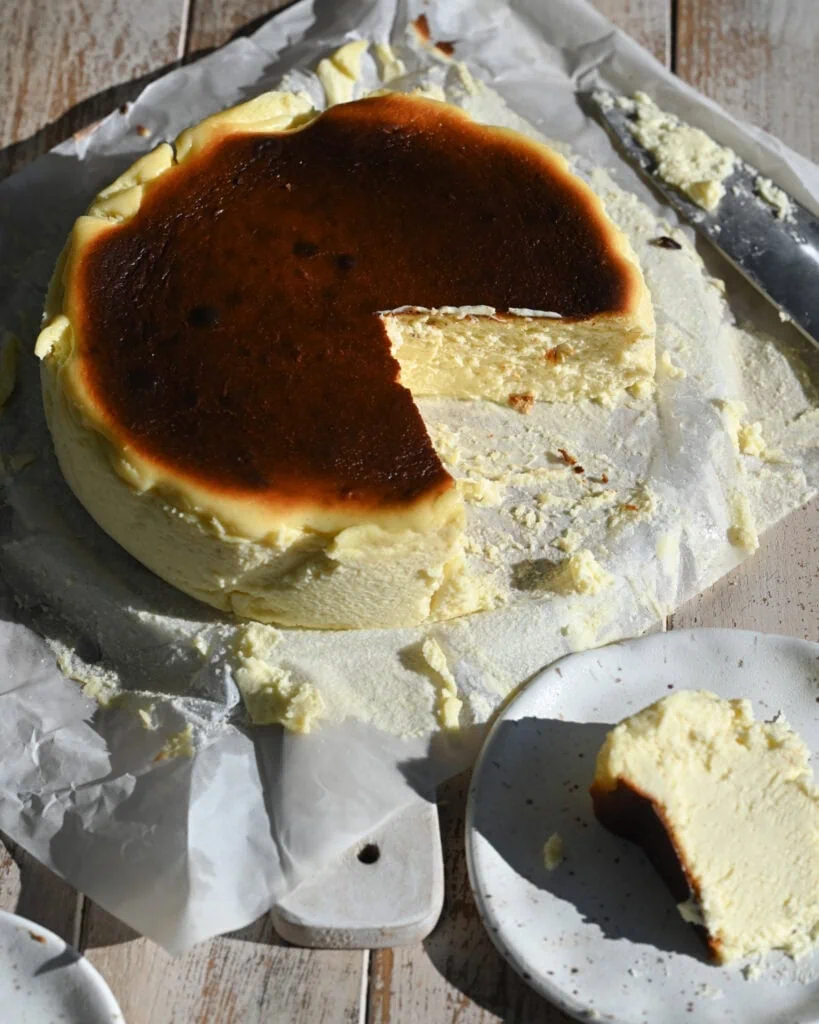
This lemon basque cheesecake might be one of the best things I have ever baked: it is definitely the best cheesecake I’ve baked (of any kind). Not only does it have a wonderfully light lemon flavor, but I’ve managed to give it an utterly irresistible texture. I do this by hybridizing the method between classic and basque. I know you are going to fall in love with it, just follow my instructions. Details below!

Recipe Origins
This recipe is made in the spirit of a classic basque cheesecake: high temperature baking, a lot of heavy cream, an easy mixing method and a cheesecake that has a light and creamy texture.
I had tackled the basque cheesecake before, in this apple cider version, preferring to add some of my own twists: using some sour cream in liu of another egg, and adding a lot of apple pie flavor (spices, brown sugar, reduced cider).
This lemon basque cheesecake also uses some sour cream and less egg, but I’ve done a few things to incorporate the lemon: lemon zest and some fresh lemon juice. You can add some lemon extract if you want it to be stronger.
Why this basque cheesecake is different
But it wasn’t just flavor that I wanted to take on here: basque cheesecakes are baked in cake pans in the oven under very high heat. This is fine for the top of the cake which makes it nice and burnt giving it that ‘burnt basque effect’ but the direct heat at the sides causes the cheesecake to have an unwelcome texture. It’s a bit thicker, kind of reminds me of an overcooked custard or scrambled eggs. I’ve always scraped away the sides to avoid it.
So here I’m doing something here that is quite traditional for a new york cheesecake, and very much not traditional for a basque cheesecake: I’m going to ask you to bake it in a water bath. I first baked this (with more or less the ingredients you see below) straight in the oven, and got those same icky sides. Only the center was as creamy as I wanted it.
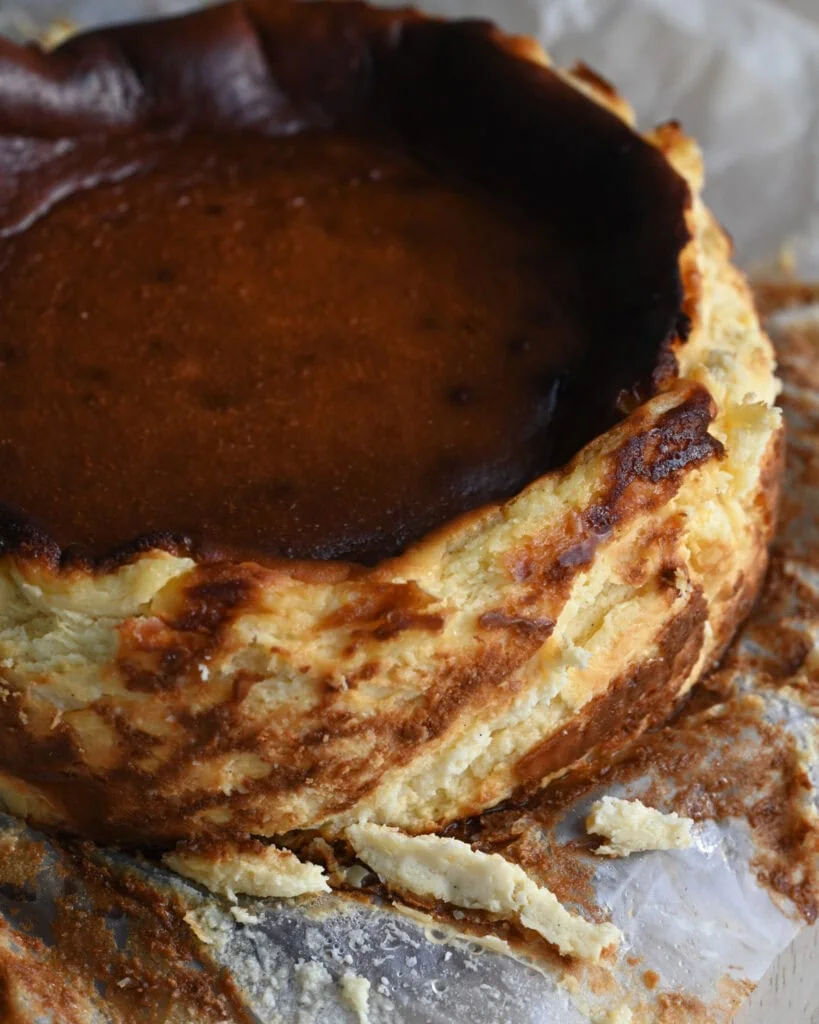
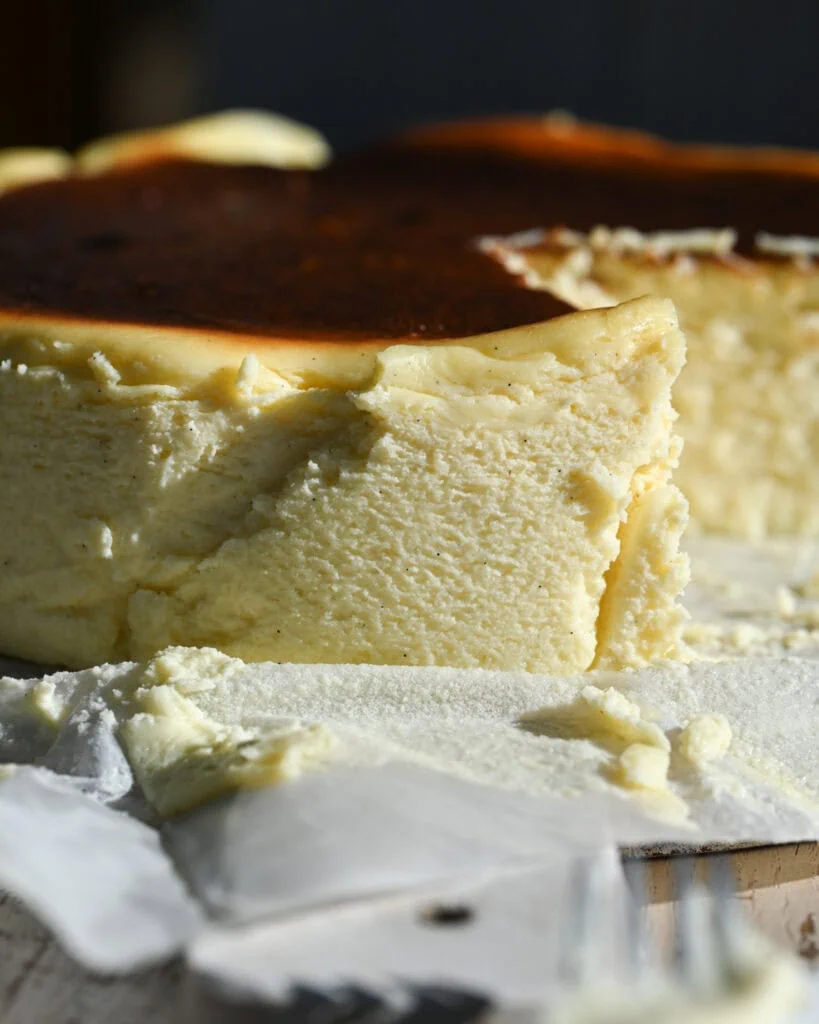
compare the sides of a cheesecake cooked without a water bath (left) and one cooked in a water bath (right)
I knew what was happening and why, thanks to years of baking cheesecakes, so I knew what I needed to do to prevent it. This is the way basque cheesecakes are usually made but I couldn’t bear it so I went back to basics.
See the water acts as a barrier between the heat of the oven and the custard; so that the custard cooks more evenly and slowly. The top, thanks to that high heat, is still going to take on that burnt look and flavor but the middle – actually everything underneath that burnt top, is going to be the creamiest, lightest cheesecake ever. The sides are not burnt (sorry) but honestly, the texture of this cheesecake is probably the best you’ll ever make. Bonus, it doesn’t sink as much.

Recipe Ingredients
Sugar: fine granulated.
Lemons: wash the lemons and rub them dry before zesting, to get rid of any unwanted coatings. I recommend three large ones but if yours are small (or you want more flavor from the zest) you can use up to five.
Vanilla: pure extract or vanilla bean paste.
Salt: fine sea salt. If using table salt, halve the amount.
Cream cheese: three bricks and they must be at room temperature. Take them out of the fridge about 2 hours before baking in the winter, and around 1 hour in the summer. If I completely forget and need to start asap, I will set the unwrapped cream cheese blocks on a plate and microwave them gently to warm them up. They should be full fat and I recommend using philadelphia as it’s quite consistent in results.
Sour cream: full fat. Ideally at room temperature but it’s ok if it’s not.
Eggs: whole large eggs at room temperature. If you forget, set them in a bowl of hot water to warm up for a few minutes.
Heavy whipping cream: or heavy cream. It does not need to be at room temperature. No substitutes.
Flour: all purpose flour.

How to make Lemon Basque Cheesecake
Make lemon sugar: do this at least a few hours ahead of time. We’re not keeping the zest in the cheesecake but we want to capture that flavor so rub it in then let it sit for awhile to ‘marinate’.

Bring the cream cheese to room temp. This is crucial before starting to make the batter.
Prep the pan: grease an 8 inch cake pan then press a sheet of parchment into the bottom and up the sides. It will crease, that’s fine!

Add the cream cheese to the bowl of lemon sugar and press it in with an offset spatula. This helps remove any lumps.

Now beat the sugar with the cream cheese, vanilla, and salt using the paddle attachment, on a medium low speed:

Beat in the sour cream: scrape the sides and bottom of the bowl as needed.

Break up the eggs and add to the batter: the goal here is to have the eggs beaten before they go into the batter so we won’t have to mix it as much:

Slowly add the eggs to the bowl and mix:

Add the lemon juice, heavy cream and flour: while the mixer is on

Pour through a fine mesh sieve:

Set in a water bath then bake

Bake until burnt but jiggly.
Let cool: first in the pan then on the counter.

Then cool in the fridge for at least six hours, it will collapse slightly as it cools

Lemon Basque Cheesecake Recipe
Lemon Basque Cheesecake
Ingredients
- 200g or 1 cup fine granulated sugar
- Zest of 3 large lemons
- 1 tablespoon vanilla paste or extract
- 1 teaspoon fine sea salt
- 678g or 3 bricks cream cheese at room temperature
- 60g or ¼ cup sour cream full fat
- 4 large eggs at room temperature
- 60g or ¼ cup freshly squeezed lemon juice
- 350g heavy cream or heavy whipping cream, cold is fine
- 2 slightly heaped tablespoons flour all purpose
Method
Do ahead:
- At least four hours before: Pour the sugar into the bowl of a stand mixer and zest the lemons over the sugar. Rub it in with your fingers. Cover the bowl with plastic wrap to seal and leave it at room temperature to ‘marinate’ for at least for hours but up to eight. We’re doing this to flavor the sugar without having to keep the zest in the batter which would make the baked cheesecake bitty and less creamy.
- At least an hour before: Bring your cream cheese to room temperature by taking it out of the fridge at least an hour before you’re ready to bake the cheesecake. Set the eggs out too, or shortly before baking place them in a bowl of hot water to warm them up.
- Preheat the oven to 425 F. Grease then line an 8 inch round metal cake pan (it should be about 2.5-3 inches tall - do NOT use a springform pan) with parchment paper, pressing it into the bottom and sides. You can use metal clips to hold it in place.
Make the Cheesecake
- Into the bowl with the lemon sugar, add the vanilla, salt, and room temperature cream cheese. Use a spatula to press the cream cheese into the sugar, smoothing it over to remove any lumps. Affix the paddle attachment and turn the mixer on low. Mix until light and creamy, stopping to scrape down the sides and bottom as needed.
- Add the sour cream and mix again, scraping as needed.
- Separately, in a bowl beat the eggs together until all white bits have been broken up (if you have an immersion blender, it will do well here).
- Turn the mixer on low and slowly add the eggs in. Then raise it to medium and beat until well combined.
- With the mixer on, add the lemon juice, then slowly pour in the heavy cream, and add the flour. Mix until the cheesecake batter is very smooth.
- Set a fine mesh sieve over the prepared pan and pour the batter through it, pressing to remove all bits.
- Set the pan in a 13x9 inch cake pan then fill the larger cake pan with water until it’s about a quarter of an inch below the rim of the cheesecake pan (don’t overfill it or you’ll have trouble carrying it to the oven without splashing).
- Bake the cheesecake for one hour, keeping an eye on any hot spots (these will show up as darker spots on the top of the cheesecake that are baking and browning faster - rotate the pan to avoid them burning) the top will have turned almost black, the center will still be quite wobbly when the pan is gently shaken.
- Take the cheesecake out of the oven, still in its water bath and let it cool on the counter. Once cool enough to handle, lift the pan out and let sit at room temperature for an hour or two. Then, transfer it to the fridge to chill for at least six hours before serving.
- Store leftovers in the fridge, in an airtight container, it’ll keep for about five days.
Did you make this recipe?
Share & tag me on instagram @buttermilkbysam


This recipe is so good!!! I made this the same day that I messed up my son’s boxed mac and cheese so was not feeling too great about my culinary skills but this turned out perfectly. So creamy and delicious subtle lemon flavor. Not hard to make, just follow the instructions and you’ll have yourself a nice treat! Thank you!!
Could I substitute some other kind of flour to make this gluten free? I was thinking about rice flour…
I would use a 1:1 gluten free substitute flour. Rice flour might make it grainy.
Sam, when you zest the lemons, do you still use a microplane and trust to sifting it out later or do you use a veggie peeler for larger zest so you can be sure to get it out? Curious about this for a couple of your other recipes too. I’m hoping to convince my lemon lover but cheesecake hater that she can like a cheesecake with this one 😉 Can’t wait!
Microplane, my sieve is fine mesh so it will get those bits out and if any are leftover it doesn’t bother me too much. I think the smaller pieces are better because they will scatter the flavor better throughout the cheesecake batter.